Tampilkan postingan dengan label Review. Tampilkan semua postingan

Review : Guitar Pro 6


I have used Guitar Pro 5 and while it has always been the defacto TAB software for guitarists the program sucked a little on OS X, for instance it only allowed a single TAB open and when you closed a TAB the entire program shut down which was annoying to say the least. Also the floating tool bar was reminiscent of Microsoft word and faded to semi-transparent when not in use which I found pointless. What it did do though was make writing guitar TAB pretty easy and when you played it back, sound pretty good using Guitar Pro’s Realistic Sound Engine (RSE).

I’m glad to say Guitar Pro 6 has had a complete overhaul of the user interface and has fixed both of the problems mentioned above by allow multiple documents to open in tabs like you would see in a web browser and the toolbar has been moved into a left hand panel. This left hand panel has 6 buttons which allow you to switch between panel views, the first opens the Editing toolbar which contains all of your notation options. The second opens the Instrument panel where you can choose the tuning of the guitar (or bass) and what RSE soundbank to use (guitar has option of Les Paul, Strat and Jazz guitars). The third button opens the Audio panel which lets you choose an amp, effects pedals and master effects such as reverb and chain up to 5. The fourth button opens the Mastering panel which include compression, limiter, gate, eq and reverb. Button five opens up the Chords panel which allows you to choose the chords that are used in your song and add them to the top of the TAB sheet and finally the last button opens the Lyrics Panel.

The result of these enhancements has made Guitar Pro 6 much easier to use, quicker to write TAB with and more realistic sounding on playback. This isn’t just a minor upgrade, if you are a Mac user this is this upgrade that finally makes Guitar Pro really worth the $60 price tag.

Cubase 5 Vs. Nuendo 4: Picking the Right DAW

How to Choose Between Steinberg's Top Digital Audio Workstations

Unlike most pro audio software manufacturers, Steinberg has two separate professional digital audio workstation flagships – Nuendo 4 and Cubase 5.

Priced at almost $1800 USD, Nuendo 4 is three times more expensive than Cubase 5. Not surprisingly, this huge discrepancy in price prompts many potential Steinberg users to ponder the differences between the two programs.

The dilemma becomes even more confusing due to the fact that both DAWs use the same core audio engine – meaning they both offer the same professional audio quality.

However, a look back at the histories and development of the two programs will make the differences between Cubase and Nuendo very clear.

The Development of Steinberg’s Cubase DAW

Having been around since the 1980s, Cubase is the older of the two programs by a long shot. Originally designed as a MIDI sequencing and editing program, Cubase evolved into a full-featured digital audio workstation over the course of the next decade and a half.

The last few versions of Cubase have become increasingly more focused on efficient ways to create and produce music. Cubase 5 is no exception as it is boasts a new feature set especially for beat creation, vocal editing and loop manipulation.

The Development of Steinberg’s Nuendo DAW

Nuendo was first conceived in the late 1990s and was initially very hard to distinguish from Cubase. In 2005, Nuendo grew into its own as a post-production flagship DAW with the release of Nuendo 3.

Nuendo 3 shared many core features with Cubase SX but added an extensive set of post-production features and networking capabilities that went miles beyond what was available in the Cubase DAW. This focus on audio post and live recording continued with the release of Nuendo 4

Cubase 5 or Nuendo 4?

Almost all the major differences between Cubase and Nuendo have to do with how each program handles "audio to picture" applications. While it is quite possible to score a picture in Cubase 5, the Cubase DAW is geared towards music creation and production. Conversely, Nuendo 4 is specifically designed to excel in professional audio post-production environments thanks to the inclusion of dozens of specialized features unavailable in Cubase.

Any users trying to decide between Cubase 5 and Nuendo 4 should pick Nuendo if they plan to be working with visual media in strict environments that require very specific professional formats. For example, Nuendo has the ability to work in 10.2 surround at 192 kHz with options for syncing to various video devices.

Cubase 5 is the obvious choice for musicians, composers and producers who have little need for the post-production features of Nuendo. In other words, it makes no sense to spend three times the money for features that are not going to be used.

Another downside to Nuendo 4 for music composers is that some of the important music creation features found in Cubase have been removed from the basic Nuendo 4 program only to be offered as an ‘Expansion Kit’ for an additional $300 USD.

Despite the obvious price difference, picking between Nuendo 4 and Cubase 5 is as simple as considering how often the DAW will be used for professional post-production work verses how often it will be used for composing and producing music.

Arcadian Audio PNOE horns speaker


Unique, smooth and round back loaded horn design

Hi-tech construction

Open, extremely detailed, warm, lifelike sound

Wide and precise soundstage

Truly a one-of a kind horn speaker!


The Pnoe horn is the culmination of a 10 year effort to design and realise a horn speaker without compromises. A team of high-end enthusiasts with deep technical knowledge and access to advanced production equipment worked through many stages of design, mathematical and physical simulations, prototype development, and countless hours of listening and blind testing. In various times listening panels of jazz and classical musicians were employed to ensure that the direction is the right one.

The Pnoe speakers are simply in a class of their own. They combine the best characteristics of single driver horn designs along with a clarity and fullness of sound which is simply unique. The sound is extremely dynamic, clear and correct. The bass extension, although not the deepest, is very fast and totally natural, unlike hybrid box/horn designs or multiple driver systems. The soundstage is wide and precise and the whole experience brings the emotions of a live performance.Voices are simply divine, horns are in the room, orchestras are alive!

This excellent performance comes with a speaker sensitivity of 100db/W along with a favourable impedance curve, which means the Pnoe is perfectly suited to be paired with the smallest high quality tube amplifiers. A 300B makes the Pnoe sing effortlessly with authority and speed reminiscent of solid state monsters.


The design objectives of the Pnoe were to:
  • Create the smoothest, roundest path for the sound wave front, without any obstructions, so that there are no sources of standing waves and spurious reflections. This was the spark which started the Pnoe concept. 
  • Choose the ideal horn design. The design of the Pnoe is the optimized result of many tests, calculations and consecutive prototypes.
  • Build the speaker precisely, using materials with a friendly sonic signature. The Pnoe is shiny in and out. It is made of fibreglass and special damping materials in the form of a sandwich, with special attention to resonance control where it is needed most.
  • Use the highest quality driver available. The AER MD3B was chosen for its ultra detailed presentation and its warm sound. It sounds like a point source electrostatic speaker with a sensitivity of 100 db/W! In the Pnoe it offers nuances like the ‘brassness’ of brass and the ‘woodness’ of violins and pianos, which have to be experienced to be believed! The reproduction of human voices is another area where the MD3B is simply in a class of its own.

Style 
The Pnoe speaker is also uniquely stylish and attractive. It is a statement of modern design and respect for natural, harmonic lines, especially important for a large speaker.


Specifications

  • Size: 220cmH * 100cmW * 90cmD
  • Weight: approx. 52 Kg
  • Frequency Response: 42-21.000 Hz
  • Max Power: 100W
  • Nominal Impedance: 16 Ohms
  • Sensitivity: 100db/1W/1m
The Pnoe speaker, being a large horn, is more suited to listening rooms with 3m or more distance between the listener and the speakers.
The standard internal wiring is the DNM Solid Core Precision and the binding posts are Eichmann Cable Pods. Both have been carefully chosen for the specific application.


Ordering

The Pnoe horn speaker is currently available only from Arcadian Audio. Standard colours for the horn body are charcoal black and ivory white. The driver mount, grille and grille fabric can be ordered from a range of colours. Each pair includes 2 sets of magnetic grilles, one with fabric and one without and 2 sets of Pnoe logos to be installed by the user.
For more information and prices, please contact Arcadian Audio.


Contact Info


Tama StarClassic

Thanksgiving is traditionally a day to remember the things for which one is thankful. I’ve found this exercise to be a lot easier when FedEx drops off a new drum kit on the day before.

Yep, this is my second new drum kit this year; the first one got sent back.

I’ve loved Tama drums and hardware since I was a kid, so when the ‘bargain’ kit didn’t work out I decided to buy the set I’d wanted in the first place. It had to be custom-ordered from Japan; between that and surface shipping, it took three days short of forever to get here. Fortunately, I wasn’t impatient or bitter, not at all. Except, well, maybe for the last six weeks. But no more than that.

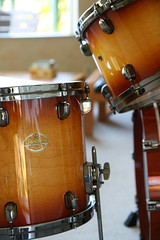
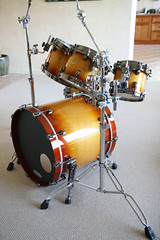
The drums are Tama StarClassic Maple, with a lacquer finish that lets the woodgrain show through. The toms are 8'', 10'', 12'' with Tama’s incredible StarCast rim-mount system, plus a 14'' with legs. I may add the 16'' later, assuming all the clubs in Sonoma County make their stages bigger first. The bass drum is 20'' in diameter by 18'' deep, and is not drilled for tom mounts because drum cages are cool even if I don’t play in a metal band any more.

There’s no snare with this kit, because Greg Gaylord just built a custom 13'' Purpleheart segment-shell with tube lugs for me, which I’ll pick up Sunday if my head doesn’t explode first from trying to contain this much awesome.

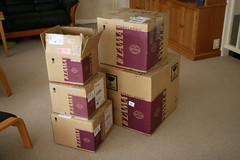
The Tama drums were shipped one to a box, with minimal packaging. The toms were pre-assembled.

Each drum was tagged with the inspector’s name and an SKU card, then bagged to keep the drums clean. Taped to each bag was a packet containing an instruction sheet and a wrench. I’m not entirely sure what the wrenches are for, but now I have a lot of them.

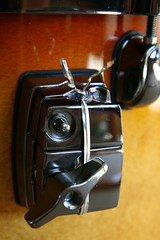
Tama’s attention to detail is impressive. Check out the floor-tom leg clamps. This is a two-piece assembly, with a memory lock that stays clamped to the leg when it is removed from the drum. For shipping, Tama’s backroom crew inserts a piece of clear plastic tube into the clamp to keep the pieces from rattling, and then loops the whole thing together with a silver twist-tie, then tucks the loose ends into the tube. It seems like a complex process, but it keeps the pieces together without marring the finish.

The kick drum needed to be put together. This was true of the Taye kit, too, although Tama pre-assembled the claws, which looked like they’d spent a lot of time on someone’s CAD workstation, not to mention the plating shop.

The drum shell had both bearing edges wrapped in a protective rubber strip — a very nice touch. The lugs were wrapped in little styrofoam bracelets.

I bought a nice Roadpro “combination stand,” and a pair of separate tom mounts. I have bags of old, or should I say “vintage” Tama hardware here, and figured I could rig up the tom mounts using the bones of drumkits past. But it was an aesthetic downer to mount the new tom holders with a pair of 20-year-old multiclamps, which look like the beer-stained, road-weary pot-metal pieces that they are, when every other chunk of metal on this kit is finished in either inch-deep chrome or black nickel. Tama hardware lasts forever, so I can’t really justify the multiclamp upgrade. Maybe I’ll settle for washing off the beer stains.

The drums came with Evans G2 and G1 clear heads. They’re a little bongy for my tastes, but I haven’t taken the time to really tune up the kit yet. I’m saving that so I have something to